

Based on the cultivation data of Raisio's contract farmers, the carbon footprint of grains for the 2024 harvest has been calculated. During the winter, 62 farmers interested in developing their farming joined the project. In addition to grain-specific carbon footprint calculations, participants also answered questions about biodiversity.
The calculations were done in collaboration with Envitecpolis Oy, and the EnvitecVisio platform was used for inputting cultivation data. The results were calculated using the Cool Farm Tool (CFT), which is currently the world's most used tool for farm-specific carbon footprint calculations.
Crop-specific carbon footprint data for farms
The farms received grain-specific carbon footprint calculations for all grains whose cultivation data had been entered into EnvitecVisio. The carbon footprint calculation for oats was done for the second time, and a large part of those who participated in the calculation for the 2023 harvest also participated for the 2024 harvest. These farms already have a comparison for two years. For some, the amount of emissions decreased, while for others it increased. The explanatory factors were yield level and fertilizer usage.
The work will continue in the coming years, with the goal of involving even more farms and covering a larger portion of the grain raw material we use in the calculations.
Excellent results for oats in 2024
The carbon footprint of oats was 0.3 kg CO2e per yield kg, which is almost at the same level as the 2023 calculation. The result is significantly lower than the Finnish average for oat cultivation, which is 0.43 kg CO2e per yield kg. Compared to last year, the yield per hectare increased, but more fertilizer was also used, so the result in terms of emissions did not change much.
The amount of nitrogen fertilization and fuel consumption had a significant impact on emissions
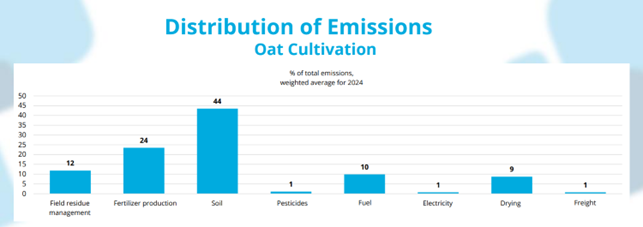
The most significant emissions in the production of all grains are caused by the use of fertilizers (fertilizer production and soil emissions). The most important thing for the result is that the desired yield increase is achieved with the used fertilizer inputs, so that emissions per yield kg do not increase.
Energy choices can also affect the amount of emissions. In Finland, grain must be dried after harvesting, and therefore the type of energy used in the dryer is important. Many farms have switched to using wood chips instead of fuel oil.
When examining the results, considering changes in long-term soil carbon stocks, the result is strongly improved by the fact that a large part of the farms have switched to lighter tillage methods (light tillage or direct sowing) and have adopted cover crops.
Peat soils have a significant impact on emissions. However, they were quite few in the review, as the number of peat fields in Southwest Finland is very small.
The calculation provides tips for reducing emissions
According to the survey, the majority of farmers involved in the calculation are adopting the lessons and information obtained from the project into their farming practices. Increasing knowledge is a significant part of the project's goals.
We are very grateful and satisfied that such a large number of Raisio's contract farmers consider the opportunity to determine the carbon footprint of their own grain production so important and interesting that they spent their time and expertise on collecting and inputting the data.
Share this
Quality Oats of Finland Come From Raisio’s Contract Farmers

Why is Raisio the best partner for contract manufacturing of plant-based drinks?